

Where Does The Middle Get Good? A Season-by-Season Guide
The Middle works from its pilot. This guide maps how its family comedy changes across nine seasons, so you can start or jump back in.
KinoShelf Journal · · 4 min read
The Middle works from its pilot. You do not need to endure a weak first season, but its focus changes as the Heck children grow up and the parents' working lives shift.
- Best starting point: Season 1, episode 1.
- Best returning-viewer entry: Pick the era that matches the family setup you miss.
- Full commitment: 9 seasons and 215 episodes, aired from September 30, 2009 to May 22, 2018.
- KinoShelf verdict: Do not skip an era for quality. Choose by which stage of the family you want to watch.
The short answer: It works from the pilot
The pilot already has the series' central idea: limited money, tired parents, three very different children, and ordinary problems that refuse to stay small. Frankie and Mike do not need a later rewrite, while Axl's apathy, Sue's energy, and Brick's attachment to books already give the children distinct comic rhythms.
Later seasons deepen those traits instead of replacing them. Start at the beginning if you want the family changes to accumulate. Returning viewers can use the three eras below without treating any of them as a repair job.
Seasons 1 to 3: The whole family under one roof
The first three seasons keep the five Hecks in their most compressed form. Frankie works as an under-performing salesperson at Ehlert Motors, Mike manages the local limestone quarry, and all three children still depend on the same crowded household.
This era has the clearest weekly family-sitcom shape. School troubles, work pressure, and domestic failures keep colliding because nobody has much physical or financial room to escape them. Sue's repeated tryouts give that pattern its most hopeful version, while Brick's reliance on books makes him the quiet counterweight to the noise around him.
Seasons 1 to 3 suit viewers who want the family packed together and each problem pulled back into the house. College-age stories do not arrive until later.
Seasons 4 to 6: New work and the first college departure
Season 4 gives Frankie the largest practical change in the series' middle stretch. She loses the dealership job, completes dental assisting school, and moves into work at a dentist's office. The job change preserves the pressure on Frankie's time, but supplies a different workplace around it.
Axl later attends East Indiana State and plays football, so the show can follow part of the family beyond Orson without abandoning the Heck house. His growth remains gradual: college expands his responsibilities, but it does not turn him into a new character overnight.
Seasons 4 to 6 keep the familiar household while sending more stories beyond it. Viewers who mainly enjoy all three children sharing the same daily space may prefer the earlier run.
Seasons 7 to 9: The children grow beyond the house
The final three seasons spread the family farther apart. Sue joins Axl at East Indiana State and majors in hospitality management, while Brick becomes the only Heck child still living at home full time. Mike's promotion to regional manager at the quarry arrives in season 9, giving the parents a late shift of their own.
The comedy stays focused on family friction, but the source changes. Shared routines now compete with college and work, so the series spends more time on how the Hecks stay connected when they no longer occupy every room together. Brick's life without a neat label also gains weight as he gets older without being rewritten into a more conventional sitcom child.
Seasons 7 to 9 foreground young-adult stories and a household adjusting to absence. Those changes carry more weight after the original family arrangement.
How long does The Middle take to watch?
Nine seasons and 215 episodes make The Middle a long commitment. Its individual plots are episodic enough for short sessions, while school, college, and job changes reward watching in order.
There is no quality threshold you must rush toward. A slower watch gives the small character changes room to register and keeps the family's recurring arguments from blurring together. If you stop and return later, the season groups above offer clean reminders of the current household setup.
Shorter and different family comedies
If 215 episodes are too many, other sitcom families under pressure offer several ways to keep the domestic friction while changing the pace. These two picks show the clearest contrast.

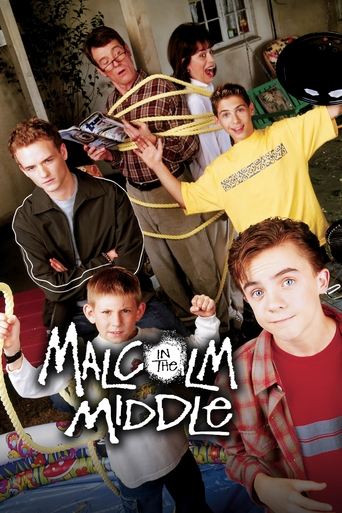
Malcolm in the Middle (2000) shares a financially stretched, dysfunctional American household, but its seven seasons move with more aggression and physical chaos. Its gifted young lead also breaks the fourth wall, creating a sharper point of view than Frankie's weary narration. Faster conflict and a shorter run make it the better fit for impatient viewers; quiet Midwest deadpan remains the reason to stay with the Hecks. The choice between the two families comes down to pace more than quality.


Modern Family (2009) also follows family problems across a long run, but spreads them among a larger, blended, multigenerational group. Its mockumentary interviews turn private reactions into punchlines, while the Hecks' limited money stays much closer to the center of daily life. It suits viewers who want more households and points of view across eleven seasons; one family's financial pressure is the reason to choose The Middle instead.