

How Accurate Are Jurassic World Dominion's Feathered Dinosaurs?
Dominion introduces feathered species to the franchise, acknowledging modern paleontology while tweaking behavior, size, and anatomy for blockbuster spectacle.
KinoShelf Journal · · 6 min read
Jurassic World Dominion (2022) finally nudges the franchise closer to modern paleontology by putting feathers on its dinosaurs, though when it comes to how these animals act, how big they are, and how the action plays out, blockbuster spectacle still wins every time. The movie swaps out decades of scaly, lizard-like designs for real plumage and fuzz, yet the moment the fossil record goes quiet, Hollywood steps in to make sure these prehistoric animals still work as terrifying movie monsters.
What the Feathers Correct in the Franchise
For almost thirty years, the series stuck pretty rigidly to the leathery, reptilian look established back in the 1993 original. Jurassic World Dominion shakes up that visual language by giving several species actual feathers, thanks in large part to paleontologist Steve Brusatte consulting on the film. Decades of fossil discoveries since the first movie have made it clear that plenty of dinosaurs - especially theropods - wore everything from simple, hair-like fuzz to full, complex feathers. The movie actually leans into that reality for a few of its newcomers, even if paleontology can only take a filmmaker so far.
While scientists can occasionally figure out feather colors by looking at microscopic pigment structures called melanosomes, things like daily habits, hunting tactics, and what these animals sounded like are much harder to pull out of solid rock. The movie happily exploits those blind spots in the fossil record, inventing hyper-aggressive predator behaviors that keep a modern thriller moving at full speed.

The Pyroraptor: Fossil Anatomy vs. The Ice Lake Chase
The Pyroraptor scene is the clearest example of where real anatomy ends and pure movie invention begins. Visually, it brings a genuinely bird-like, feathered silhouette into a franchise that spent decades giving us naked, scaly raptors. Its bright red plumage and wing-like arms line up nicely with what paleontologists generally expect dromaeosaurs to look like, even if we don't have fossils telling us the exact colors or feather patterns of this specific animal.
Once it hits the frozen lake, though, we're firmly in the realm of Hollywood imagination. Watching it smash through solid ice and torpedo through freezing water like a feathered penguin to hunt down humans is a blast, even if there's zero fossil evidence suggesting Pyroraptor was built for diving or under-ice ambushes. That whole sequence was designed to get your heart racing, not to pass a peer-reviewed ecology check.
The Therizinosaurus: Claws, Feathers, and Threat Behavior
The movie introduces the Therizinosaurus covered in a coat of downy filaments, giving it a fuzzier, very different profile from the sleek, winged raptors. Those absurdly long claws - a completely real trait that baffled early paleontologists when they first dug them up - give it one of the most unforgettable silhouettes in the series.
Where the movie takes liberties is turning a plant-eater into a territorial slasher-movie villain. Sure, modern herbivores like hippos and rhinos can be terrifyingly dangerous if you get in their space, but the slow, methodical way the Therizinosaurus stalks its prey through the fog is pure horror-movie staging. It's there to milk every drop of tension out of a dark forest, not to show how a prehistoric browser actually spent its afternoons.

The Giganotosaurus: A Movie Antagonist vs. A Fossil Animal
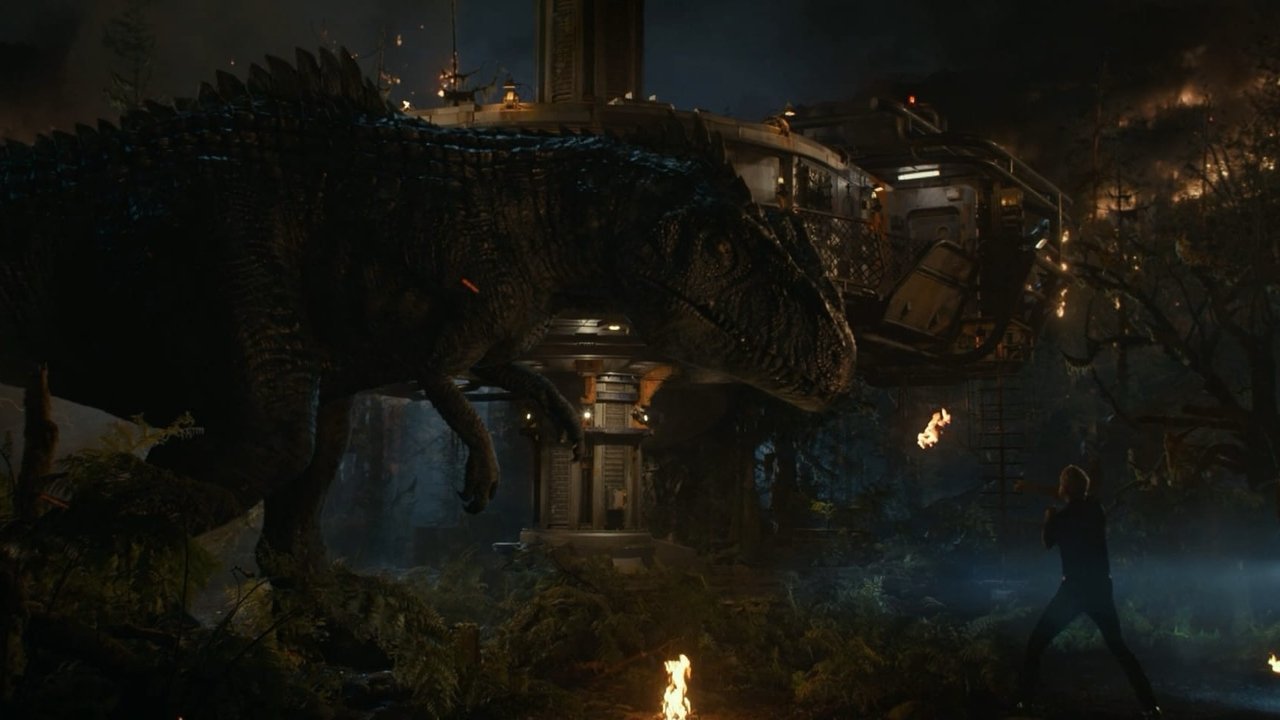
Because the movie wants a clear-cut dinosaur villain, it ends up tweaking the Giganotosaurus's actual biology to fit the part. In real life, this was a massive carcharodontosaurid meat-eater, not a spiky, armor-plated kaiju. The filmmakers gave it a ridge of jagged, crocodile-style spines down its back and framed every shot to make it tower over its competition. None of that comes from the fossil record, of course, but visually it immediately tells the audience, "Here's your main bad guy." An actual Giganotosaurus was just a predator trying to make a living in its ecosystem, not a brooding movie villain nursing a personal grudge.
The Quetzalcoatlus: Pterosaur Mechanics and the Aircraft Attack
One of the coolest - and wildest - set pieces in the movie features a Quetzalcoatlus tearing into a cargo plane mid-flight. First off, it's worth noting that Quetzalcoatlus isn't actually a dinosaur; it's a pterosaur, part of a separate family of flying reptiles that shared a common ancestor with dinosaurs and ruled the skies alongside them.
Even though it was one of the biggest things to ever fly, with a wingspan roughly the size of a small plane, the physics of that mid-air brawl really stretch things. Pterosaurs could only get off the ground because they had paper-thin, hollow bones and built-in air sacs keeping them light. Slamming repeatedly into the metal fuselage of a modern cargo plane would put catastrophic stress on a skeleton that delicate, so the movie quietly gives it a level of durability no real flying animal could ever survive.
Flesh on Bones: How Animatronics and CG Brought Them to Life
A big reason these creatures feel so tangible on screen is the heavy mix of old-school practical effects and modern CGI. Creature effects supervisor John Nolan mentioned that his crew built around 38 practical dinosaurs across roughly 14 different species just so the actors had something real to react to on set. Even the massive Giganotosaurus had a working, life-sized animatronic head and neck on location, while VFX supervisor David Vickery’s digital artists handled the full body whenever the camera pulled back for wide action shots.
The Pyroraptor needed that exact same tag-team effort between practical and digital crews. Nolan's team built a physical animatronic head covered in hand-woven, custom-dyed feathers, which gave Vickery's VFX team a real-world texture reference to match on their digital model - especially tricky when they had to figure out how wet, matted feathers would move and clump together in freezing water and snow.

Why Science and Creature Drama Diverge
At the end of the day, Jurassic World Dominion (2022) lives right in that tug-of-war between real science and what an action movie needs to work. Bringing in feathers proves the filmmakers actually listened to their paleontology advisors. Still, if the movie played things strictly by the scientific book, most of these animals would spend their screen time conserving energy and steering clear of pointless fights rather than hunting people across continents.
An action thriller needs relentless threats, so real prehistoric animals inevitably get turned into movie monsters. Even while the broader story wrestles with what human and dinosaur coexistence resolves across the globe, the creature design boils down to a pretty simple trade-off: borrow the anatomy from the fossil record, and leave the behavior to Hollywood.